

Now Reading: The Ghost in the Machine: How AI is Composing, Producing, and Changing the Sound of Music
- 01
The Ghost in the Machine: How AI is Composing, Producing, and Changing the Sound of Music
The Ghost in the Machine: How AI is Composing, Producing, and Changing the Sound of Music

For centuries, music creation has thrived on a romantic mythology of human genius. We envision the solitary artist: Beethoven, hunched over a piano, battling deafness to compose a symphony; Joni Mitchell with a guitar, weaving heartbreak into poetry; or a DJ in a darkened club, masterfully blending beats to move a crowd. This image relies on inspiration, emotion, and a uniquely human spark. However, by 2025, a new presence has entered the studio: a silent collaborator whose influence grows exponentially. It is a ghost in the machine, Artificial Intelligence, and it has evolved from a futuristic concept into a force that actively composes, produces, and fundamentally alters the very sound of music.
As a musician, I’ve had to endure many different shifts in technology that completely changed the industry or fundamentally altered (made obsolete) the way that things are accomplished, and AI is no different.
AI’s most profound and controversial application lies in composition. What started as rudimentary experiments in algorithmic music has transformed into sophisticated neural networks that generate entire songs from simple text prompts. Platforms like Suno and Udio have gone viral, enabling anyone to become a composer, conjuring everything from sea shanties about their pets to surprisingly coherent pop anthems in seconds. While some dismiss these as mere novelties, serious artists embrace the underlying technology. For a musician facing a blank page, AI serves as an inexhaustible brainstorming partner, generating a unique chord progression or a catchy melodic fragment to break through writer’s block. Artists like Grimes have pushed the boundaries further, openly releasing an AI model of her voice for others to use, inviting a new form of decentralized AI-assisted collaboration. The line between tool and creator blurs, prompting a fierce debate: can an algorithm truly be creative, or is it merely a sophisticated mimic?
While AI composers dominate the headlines, the technology is quietly transforming music production. For decades, mixing and mastering, which involve balancing the various sonic elements into a polished professional product, remained a dark art accessible only to trained engineers working in expensive studios. Today, AI-powered software democratizes this crucial process. Tools like iZotope’s Ozone analyze tracks and apply equalization, compression, and stereo imaging in seconds, achieving results that rival human engineers. This technology becomes a secret weapon for bedroom producers, leveling the playing field and dramatically speeding up their workflow.
Additionally, AI-driven stem separation proves revolutionary. This technology allows producers to flawlessly isolate vocals, drums, or bass from fully mixed recordings, a task once deemed impossible. As a result, it unlocks unprecedented potential for remixing, sampling, and even historical restoration, as exemplified by the creation of The Beatles’ final song, “Now and Then.”
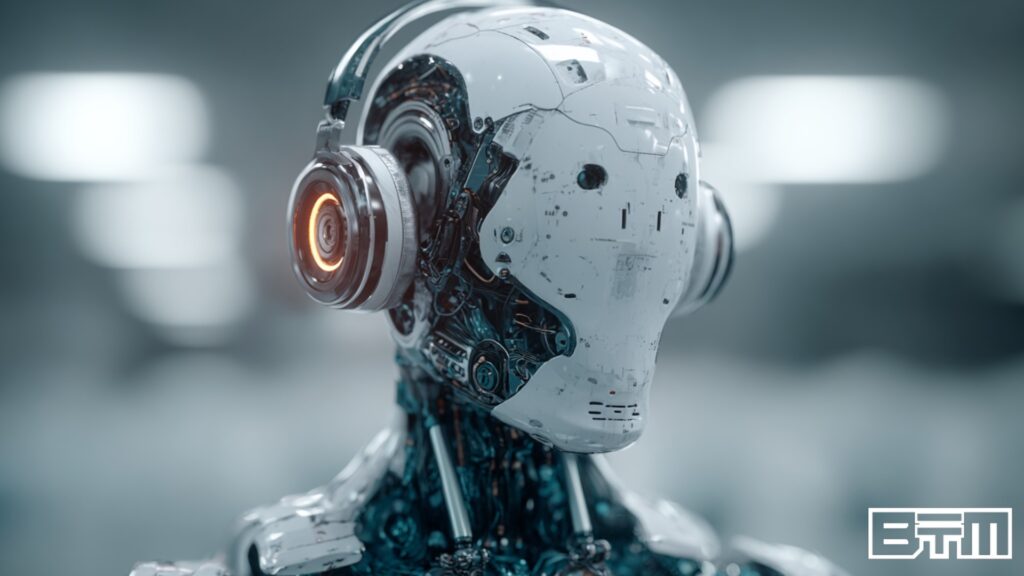
Beyond simply assisting in the creation of traditional songs, AI is forging entirely new sonic palettes and redefining our relationship with music as a functional medium. By analyzing vast datasets of sounds, AI can generate novel digital instruments and textures that would be impossible for a human to conceive of manually. This expands the creative toolkit for avant-garde producers and film composers alike. More transformative still is the rise of generative music for wellness and focus. Apps like Endel and Brain.fm use AI to create personalized, adaptive soundscapes that respond to a user’s location, heart rate, or time of day. In this model, music is no longer a static, pre-recorded product; it is a dynamic, functional service. It’s a soundtrack for your life, composed in real-time by an algorithm, designed to help you focus, relax, or sleep.
This rapid integration is not without its perils. The music industry in 2025 is grappling with a tidal wave of legal and ethical quandaries. The most pressing is copyright. If an artist uses an AI to generate a melody, who owns the rights: the artist, the AI developer, or no one at all? What happens when AI models are trained on the entire catalog of existing music without permission from the original artists, learning to replicate their styles with uncanny accuracy? These questions are being fought in courtrooms and boardrooms around the globe. Yet, for all its power, the one thing AI cannot replicate is the core of human artistry: lived experience. An AI can analyze every love song ever written, but it has never felt love or loss. It can mimic the structure of a protest anthem, but it has never fought for a cause.
Hate it, or love it! The ghost in the machine is here to stay. It is not an artist, but a new kind of instrument, arguably the most powerful since the invention of the synthesizer or the sampler. It is a mirror reflecting the entirety of our recorded musical history back at us, able to combine and mutate it in infinite ways. The musicians who fear it risk being left behind, while those who learn to collaborate with this new intelligence, who wield it with intent and emotion, will be the ones who compose the truly groundbreaking sounds of the future.
Related Posts


Stay Informed With the Latest & Most Important News
Previous Post
Next Post








Advertisement